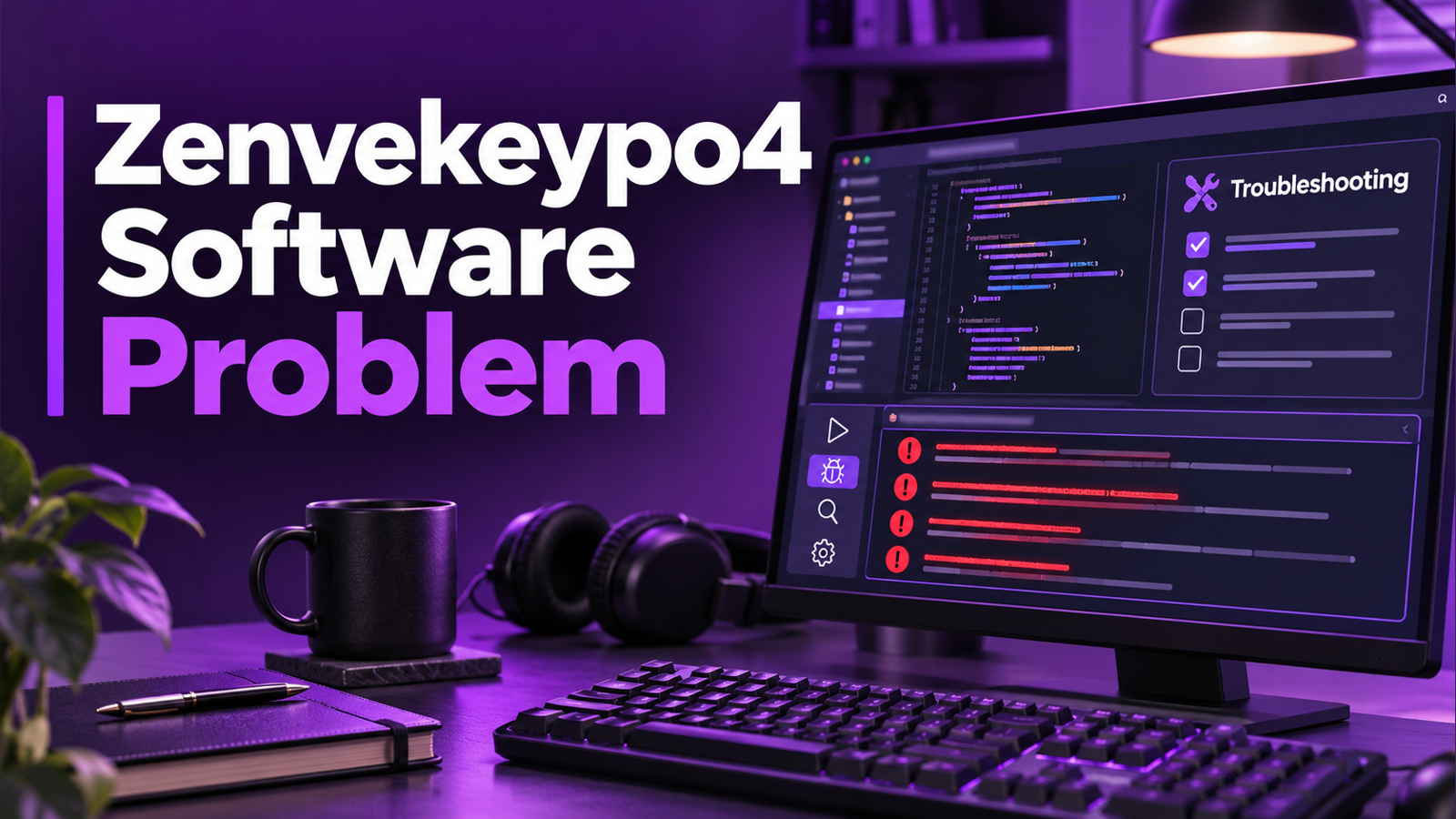
A Zenvekeypo4 Software Problem should be approached by identifying the actual program and its exact error. No reliable diagnosis follows from the name alone, and no authoritative public Zenvekeypo4 release or support manual was established in the research for this article.
That limitation does not prevent useful troubleshooting. You can determine whether the issue belongs to a browser, local executable, configuration file or documented Python project. The key is to work from observable evidence and avoid attaching invented features or requirements to an unverified software label.
Find out what failed before deciding why
Begin with the action that produced the problem. Did you open an application, submit a web form, load a document or start a script? Write down the result in concrete terms. A blank page, closed window and exception traceback are distinct observations even when all are described casually as a software issue.
Identify the message’s source. A page claiming that a program has a problem does not establish that the program is present on your device. A browser notification may come from a particular site, while a local dialog may belong to an installed executable. The source determines which evidence should be collected next.
Record whether the failure is consistent. If the same steps sometimes work, note the conditions around successful and unsuccessful attempts. Avoid changing several conditions at once during comparison. A controlled test helps distinguish a local configuration issue from an input-specific or remote-service failure.
Understand the evidence gap around Zenvekeypo4 Software Problem
An accountable publisher, dependable release record and technical specification were not verified in the material reviewed. As a result, this guide cannot responsibly assign the software a supported operating system, minimum memory, price or official patch. Those facts need original documentation tied to a real release.
This is not the same as proving that no private project uses the name. A workplace tool could have internal documentation and restricted distribution. If that applies, obtain information from the organization that supplied it. Unrelated public articles should not replace the authentic source for a private installation.
The same restraint applies to security conclusions. An unfamiliar name is neither a safety certificate nor proof of malware. Verify the file and its source before making a judgment. What matters for a repair decision is whether the program and proposed change can be connected to reliable evidence.
Make a baseline you can restore
Before resets or reinstallations, locate important documents and application configuration. Keep a backup outside the folder being modified. If the program stores data remotely, understand the account and export process before removing local components. Do not assume that uninstalling preserves everything.
Save the original error and current launch settings. Include the executable path, working folder and runtime information where relevant. A baseline helps compare later attempts and avoids losing the only record of what was initially wrong.
When you make a change, document it in ordinary language and repeat the same test. Record the actual result, including a different error if one appears. This produces a useful sequence for support and prevents a pile of unrelated adjustments from obscuring which action mattered.
Check local files and launch configuration
A program may fail because its shortcut points to a moved file or because supporting resources were not extracted with it. Compare the target and folder structure with authentic documentation. Do not download individual replacement files from unknown sources simply because a message mentions a missing name.
Relative paths are another common source of confusion in software generally. A script can request a settings file relative to its current working directory, which may differ when launched from a shortcut. The file may exist but not where the program is looking.
The Python pathlib documentation explains path handling for genuine Python projects. This is useful background when Python is actually involved. It should not be turned into a claim that Zenvekeypo4 uses a particular directory layout or programming language, neither of which was established here.
Distinguish environment errors from product identity
If an authenticated application uses Python, its interpreter and dependencies should match its setup instructions. An editor may run a different environment from a terminal or desktop shortcut. That can explain why a library appears installed but cannot be imported by the failing process.
Inspect the actual interpreter instead of assuming all Python commands use the same installation. python -c "import sys; print(sys.executable)" reports the executable used by that command. Use the appropriate command name on your system and compare the result with the legitimate project’s configuration.
Python’s virtual environment guide describes how separate projects can maintain different packages. That separation helps manage compatibility. It does not authenticate unknown code or prevent it from accessing resources available to your account, so it is not a substitute for verifying the application.
Read error messages as evidence
For a real Python traceback, retain the final exception and the preceding context. An import problem, missing-file problem and permission problem require different next checks. The official errors and exceptions tutorial explains how these messages describe failures.
Do not hide an exception merely to remove the visible warning. A program that continues after incomplete initialization may produce incorrect output or fail later in a less understandable way. Error handling should reflect the application’s design and recoverable conditions, rather than swallowing every failure indiscriminately.
If the issue belongs to a browser or remote service instead, preserve the relevant response and account context. Do not apply Python commands to a web problem without evidence that the local Python environment is involved. Matching a tutorial’s keywords is not the same as matching its technical situation.
Assess a repair before applying it
A credible fix identifies the affected version, explains the cause and states what will change. It should be possible to connect it to the actual publisher or a well-understood component. Broad promises such as fixing every error without diagnosis deserve skepticism, even when they repeat the exact phrase you searched.
Avoid disabling protection or granting administrator access as a routine first move. Determine the specific denied resource and whether the requested access is necessary. An unexplained permission increase can expose more of the computer without addressing an incorrect path, missing configuration or incompatible dependency.
For related context, our Python startup failure article explains environment mistakes, while our software update verification guide discusses release evidence. These resources support careful diagnosis, not an assertion that a verified Zenvekeypo4 patch or download channel exists.
Confirm the whole workflow after a change
Successful startup is only one checkpoint. Repeat the original task with non-sensitive test input and inspect the output. Confirm that saving, processing and any legitimate service interaction work as expected. The disappearance of one warning does not establish that all affected behavior has recovered.
Keep the prior working state until the result is stable. If the issue returns, compare its exact error with the earlier record. Similar symptoms can have different causes, and a previous remedy should not be repeated automatically without checking whether the underlying condition matches.
When the application source cannot be verified, stop experimenting with replacement installers. Seek support for recognized components or use a documented alternative for the task. A dependable process matters more than completing an installation under an uncertain name.
Frequently asked questions
What should I do first?
Identify the source of the message and preserve the complete error. Establish whether a local application actually failed before making changes to the computer.
Are official Zenvekeypo4 requirements confirmed?
No authoritative release requirements were established in this review. Hardware, runtime and compatibility claims should come from an accountable publisher and match the actual version.
Will a virtual environment make an unknown program safe?
No. It separates dependencies but is not a security sandbox. Verify the program and its origin before execution.
Should I share my full configuration for help?
Share only what is necessary and redact credentials, tokens and private information. Preserve technical context while keeping the unedited original in a private location.
When is the issue truly resolved?
When the original workflow completes and its output is correct under the same test conditions. Keep a record of the supported change that produced that result.
About the Author