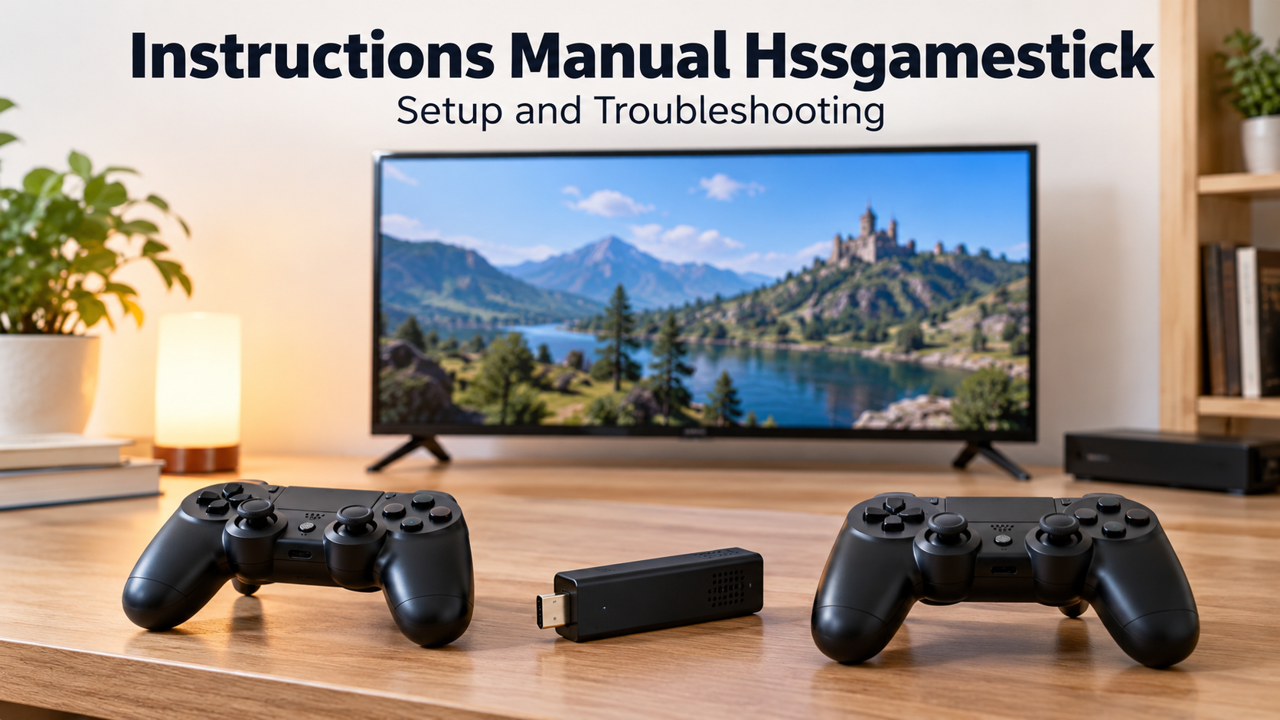
Finding Instructions Manual Hssgamestick is only the beginning of learning a retro gaming stick. The useful manual is the one that matches your unit's model, revision and installed software. Our 26 October 2026 review found general HSSGamestick guidance but did not authenticate a single manufacturer manual applying to all similar devices. This article explains everyday concepts and cautious checks without claiming that every stick has the same menus, game library or shortcuts.
Keep a record of your own unit
Before changing anything, photograph the device label and supplied instructions. Note the power requirement and any model or revision identifier. Keep the receiver and controllers associated with their original package. A small HDMI device can look almost identical to another while using different internal hardware. That difference matters for firmware, storage images and sometimes the input configuration, even when online photos appear to match.
When asking a seller for help, provide those identifying details rather than just the name HSSGamestick. Ask for the manual that corresponds to the label and installed menu. A general article can explain concepts but cannot establish compatibility with your hardware. We have not tested your device, so we do not promise a fixed number of games, automatic saving or a particular combination that always returns to the menu.
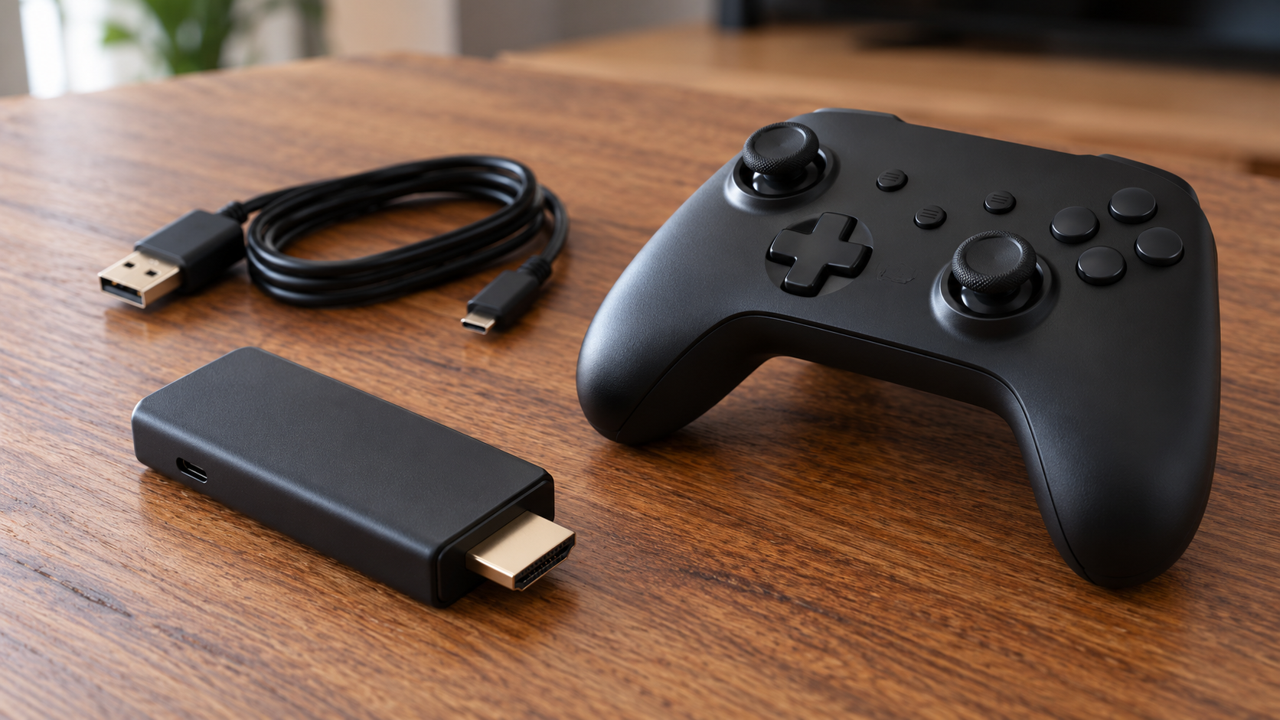
Learn the menu before a long session
Start by navigating the main screen with one controller. Establish how to select, go back and open any available settings using the matching instructions. Do not change several options while learning. Take a photograph of the working configuration so you can restore it later. A small note about the controls is often more useful than relying on memory after an extended break from playing.
Launch a simple game you are entitled to use and test each important action. Confirm that the buttons behave as expected inside the game as well as in the menu. The same physical button can serve different functions in different software contexts. Understanding that distinction prevents a common mistake: treating a correct menu response as proof that every game's mapping or player assignment must already be correct.
Controller labels are not the whole mapping
A button's printed letter describes the physical controller, while the emulator may translate it into another system's layout. This can make confirm and cancel feel reversed or place actions in unfamiliar positions. Review any supported mapping options gradually. Make a change for the intended game or profile where the software allows it, rather than unintentionally changing every title because one particular layout feels awkward.
If two players are involved, check the port assignments and the game's own joining method. Some games use alternating turns instead of simultaneous play. Some require player two to join at a specific screen. Test that behaviour rather than assuming a second controller guarantees shared-screen play in every title. The correct arrangement depends on the game and installed software, not simply the number of controllers in the box.
Understand saves and save states
A game's internal save follows its original design. An emulator save state, where supported, captures an emulated moment and may include conditions beyond the game's normal save system. They are related but not interchangeable. Establish which one you are using and how it is loaded before depending on it. A menu label alone may not make the distinction obvious to a new player.
Practise on progress you can afford to lose. Save, exit through the documented procedure and confirm the progress can be loaded again. If more than one person plays, label or organise slots where the software permits it. Loading the wrong state can move a session backwards, and saving over an occupied slot can replace another person's progress. Clear habits matter even when the device technically supports several slots.
Use software documentation conditionally
Some gaming devices use RetroArch, whose official documentation explains its input system and Quick Menu. That is a useful resource only after you establish that the software is actually present and identify any vendor changes. A guide for standard RetroArch is not automatically a guide for every game stick. Do not infer a menu path from a screenshot of another unit or a similar-looking controller.
The official Quick Menu description includes actions related to content and state management. Consult the applicable documentation to learn the intended controls for your configuration. This article deliberately does not prescribe a universal hotkey because an incorrect combination could perform another action. Once the proper method is verified, write it down beside the device's other everyday controls so a second user can follow the same routine.

Make the picture comfortable rather than elaborate
Choose display settings supported by the hardware and television. Keep a stable working output before experimenting with visual filters or higher resolutions. If older games appear wider than expected, inspect aspect-ratio controls where available. A widescreen television can stretch material designed for another shape. Whether you prefer borders or stretching is a presentation choice, but understanding the cause prevents unnecessary troubleshooting.
If the picture disappears after a settings change, follow the exact model's documented recovery process. Do not assume the device has failed or immediately install replacement firmware. Our research does not establish one recovery sequence for all HSSGamestick revisions. Recording the original setting and changing one option at a time makes it much easier to identify what happened and explain it to the seller if support is needed.
Shut down and handle storage deliberately
Use the shutdown method specified for your unit and allow any save operation to finish before removing power. Where removable storage is present, do not pull it out during use. Keep it associated with the device and avoid unnecessary writes from another computer. It may hold operating software and settings in addition to games, so an accidental format can affect the entire system.
If a computer cannot recognise the card, that is not permission to erase it. Establish its format and make an appropriate backup before authorised changes. Use only compatible, legitimately obtained content. A tutorial promising thousands of extra games does not establish that the files are licensed or that the card image matches your hardware. We do not provide a universal download pack, firmware image or shortcut around those checks.
Deal with ordinary faults methodically
For a controller problem, check power, receiver and connection method before remapping. For missing audio, check television mute and output selection before resetting the device. For a blank screen, confirm the input and specified power source. These checks address different parts of the setup. Changing all of them at once makes it harder to understand which factor produced the problem or resolved it.
Instructions Manual Hssgamestick should lead you toward matching documentation and repeatable habits. Identify the unit, learn controls, test saving, preserve working settings and avoid speculative firmware. The goal is comfortable everyday play, not an endless sequence of tweaks. A short record of the settings and procedures that actually work on your own device is often the most useful companion to its supplied manual.
Documentation used for this guide
For the underlying material, consult The HSS-branded general article reviewed, Official RetroArch input documentation, where applicable, Official RetroArch Quick Menu documentation, where applicable. Product descriptions are attributed claims; illustrative photographs are not product screenshots or evidence of hands-on testing.
More reading on this website
Riproar Tech News: Understand the Coverage
Betterthisfacts Information by Betterthisworld: Read With Context
About the Author