“Ohio champion trees delaware county usd lewis center” is a search for information about notable large trees around Delaware County, Ohio. It is not evidence on its own of an official attraction or a school-affiliated champion-tree project.
The strongest reviewed record is an indexed Ohio listing of an eastern cottonwood in Delaware County. Treat that as a documented listing, while checking present-day status and access separately.
Ohio champion trees Delaware County USD Lewis Center: what is established?
The geographic focus is Delaware County in Ohio. Lewis Center helps describe the area of interest, but the available evidence does not justify attaching every county record to a specific Lewis Center address. “USD” remains unexplained in the reviewed sources.
A useful article should say when the wording is uncertain. Otherwise, a repeated search phrase can gradually turn into a made-up organisation or place name. Keep the query as a query until a reliable source identifies the claimed entity.
A champion is a category record
The indexed ODNR native champion-tree page includes a Delaware County eastern cottonwood. The direct page could not be accessed in the 28 October 2026 review, so its latest status was not independently confirmed.
Calling a tree a champion normally requires knowing the species and the relevant competition or register. A state species record and a national record are different distinctions. Avoid changing one into the other merely because a tree looks exceptionally large.
The tree’s age is another separate question. A large trunk does not give an exact planting year, and a historical record does not prove a popular claim about how many centuries the tree has lived. An age estimate needs its own basis.
How size comparisons become misleading
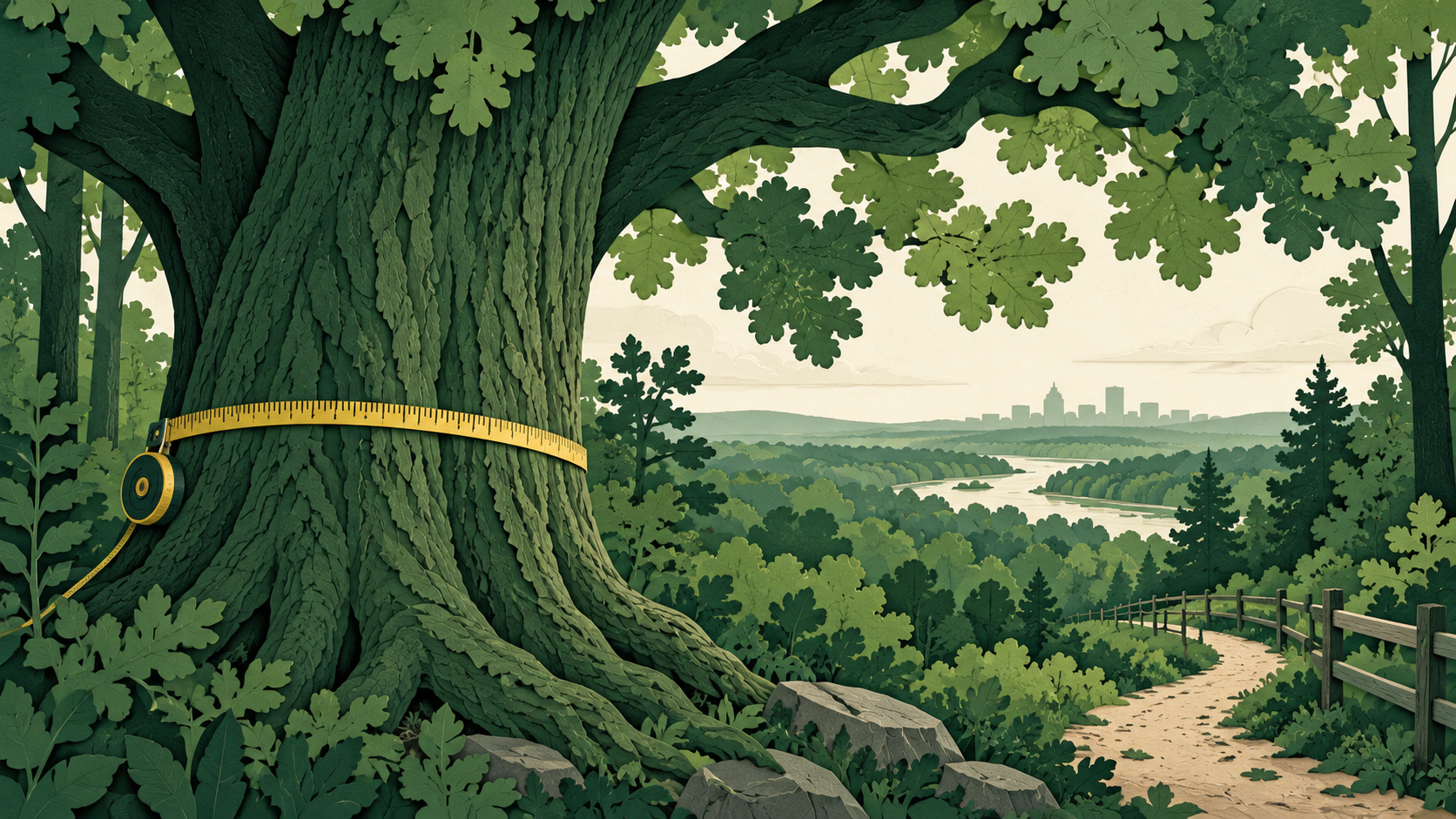
American Forests’ introductory guidance identifies trunk circumference, height and crown spread as the measurements used in champion-tree nominations. A dramatic photo provides none of those reliably on its own.
Camera distance and perspective can make a person look tiny beside a tree. A wide-angle photograph may emphasise the trunk or conceal how far the canopy extends. Enjoy the picture, but do not turn its visual impact into a measurement.
Likewise, the tallest tree need not have the highest combined score. One specimen may gain more from its trunk circumference, another from height or crown spread. Compare like categories with the same method before describing a winner.
A better way to follow up a local tree story
Start with the responsible record programme, then use local educational sources such as the Delaware County Master Gardener Association for context. Ask what is known about the current record, who manages the location and whether a visit is permitted.
If you see a very large tree yourself, take notes without damaging it or entering restricted land. Record the broad location privately and ask the appropriate programme how to submit a candidate. Do not announce a new champion before the identification and measurements have been assessed.
The approach resembles our guides to reading information with context and planning from online ideas. An interesting lead is a reason to investigate, not a substitute for confirmation.
A strong local nature story can be engaging while acknowledging limits. Naming the species correctly, separating past records from current observations and respecting access are more useful than adding an unsupported superlative.
Frequently asked questions
Is the biggest-looking tree automatically a champion?
No. A record depends on the species, measurements and relevant programme criteria.
Is the oldest tree necessarily the largest?
No. Age and size are different questions; neither can simply be substituted for the other.
Does the query identify a school project?
No verified school affiliation was established.
Can I nominate a large tree I find?
Ask the responsible programme about its current nomination process and measurement requirements.
Is today’s access to the recorded tree verified?
No. Confirm present-day location and permission with the relevant land manager.
Sources
- ODNR: indexed native-tree listing, direct page unavailable during review
- American Forests: nomination measurements
- Delaware County Master Gardener Association
About the Author