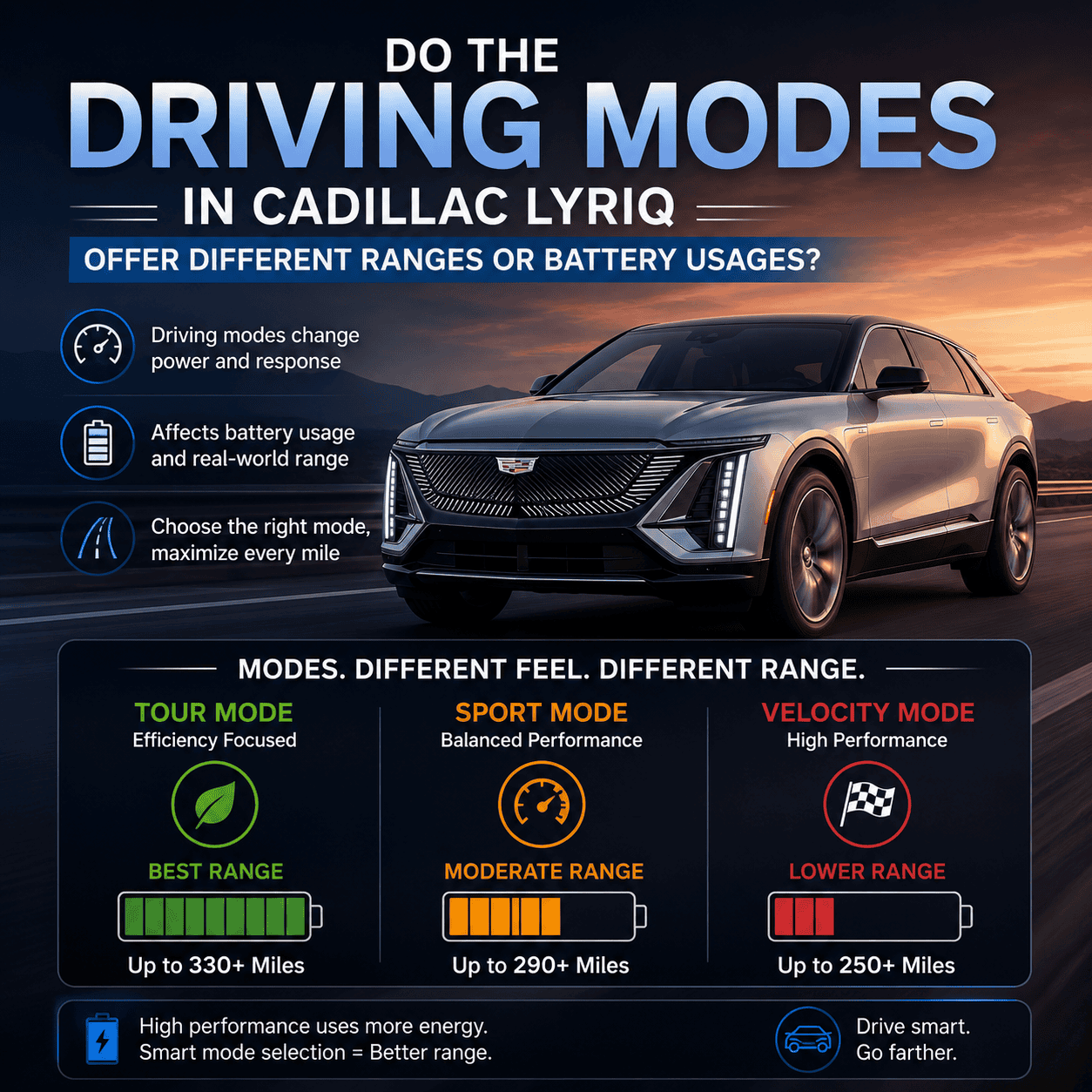
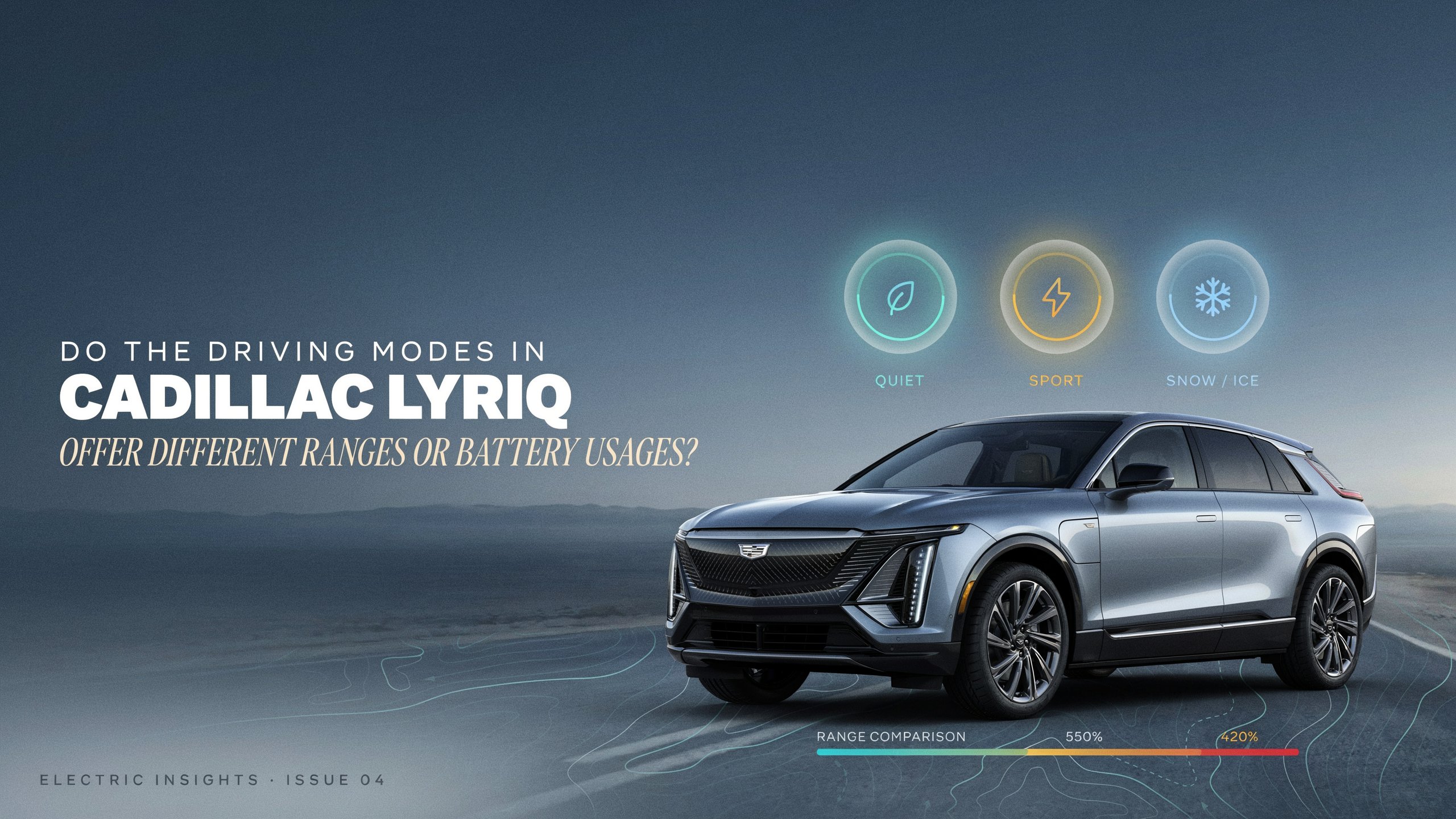
Driving modes in the Cadillac LYRIQ directly alter battery usage and real-world driving range by changing accelerator pedal sensitivity, motor power output, and electrical energy draw. Selecting high-performance settings like Sport or Velocity mode causes the electric motors to pull energy from the battery faster during acceleration, whereas Tour mode optimizes power delivery to help preserve driving range.
Overview of Cadillac LYRIQ Driver Mode Control System
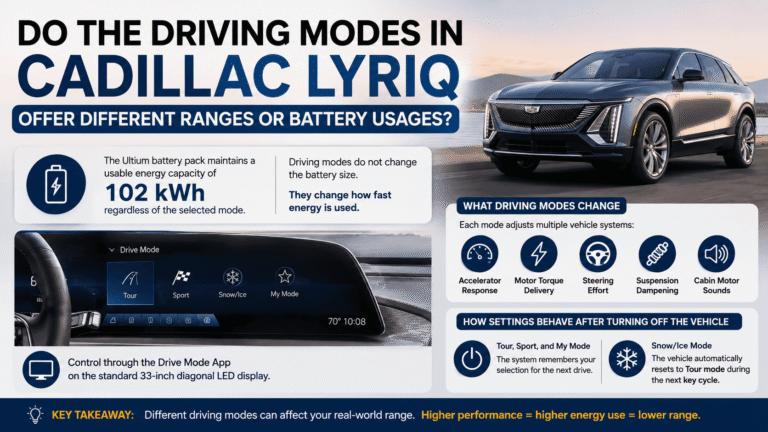
The Cadillac LYRIQ uses a Driver Mode Control system that adjusts vehicle performance based on driver preference and road conditions. Drivers control these modes through the Drive Mode App located on the standard 33-inch diagonal LED display screen.
Changing the drive mode adjusts multiple vehicle subsystems at the same time. These subsystems include accelerator pedal mapping, electric motor torque delivery, steering effort, suspension dampening, and cabin motor sounds.
The drive mode software changes how the car responds when you press the accelerator pedal. It does not change the physical capacity of the battery pack. The Ultium battery pack maintains a usable energy capacity of 102 kilowatt-hours (kWh) regardless of the selected mode. However, the rate at which power is drawn from those 102 kWh changes depending on the mode you choose.
System settings behave differently when the vehicle turns off. If you leave the vehicle in Tour mode, Sport mode, or My Mode, the system retains that setting when you turn the vehicle back on. If you select Snow/Ice mode, the vehicle automatically resets to Tour mode during the next key cycle.
Detailed Breakdown of Available Drive Modes
Tour Mode
Tour mode is the default driving mode for the Cadillac LYRIQ. Cadillac engineered this setting for everyday city commuting and highway driving. It balances passenger comfort, smooth handling, and electrical efficiency.
In Tour mode, pedal mapping is linear and progressive. Pressing the accelerator pedal results in smooth, controlled power delivery. This setting minimizes power spikes from the battery pack, making it the most energy-efficient profile for general driving. Steering effort remains light and comfortable for easy maneuvering.
Sport Mode
Sport mode recalibrates the vehicle for responsive, dynamic driving on dry roads. When active, the system modifies throttle tuning, steering effort, adaptive suspension dampers, and interior acoustic sounds.
The accelerator pedal becomes much more sensitive in Sport mode. The same foot placement on the pedal requests significantly more torque from the electric motors than it does in Tour mode. Steering effort increases to provide firmer feedback through the steering wheel. Models equipped with Continuous Damping Control stiffen the suspension to reduce body roll during cornering.
Snow and Ice Mode
Snow/Ice mode is designed specifically for slippery road surfaces covered in snow, ice, slush, or loose gravel. This mode alters accelerator pedal tuning to reduce throttle sensitivity.
Dampening the pedal response prevents accidental tire spin when starting from a complete stop. On All-Wheel Drive (AWD) models, Snow/Ice mode adjusts the electronic torque split between the front and rear electric motors. This helps maintain traction and stability. Snow/Ice mode is not meant for freeing a vehicle stuck in deep mud or snow banks.
My Mode Customization Options
My Mode is a fully customizable driving profile that allows drivers to mix and match subsystem settings. It retains its settings across engine power cycles.
Drivers can adjust specific settings through the infotainment display. Selectable options in My Mode include:
- Acceleration Feel: Relaxed, Tour, or Sport.
- Brake Feel: Tour or Sport.
- Steering Effort: Tour or Sport.
- Suspension Tuning: Tour or Sport.
- Motor Sound: Tour or Sport.
This feature allows drivers to set steering and suspension to Sport for firmer handling while keeping Acceleration Feel set to Relaxed or Tour to conserve battery power.
Velocity Mode and Velocity Max
Velocity Mode is available on select trim levels or as a factory performance upgrade. On vehicles equipped with this option, Velocity Mode replaces Sport mode on the drive mode menu.
Velocity Mode increases available propulsion torque beyond standard Sport mode settings. On the high-performance LYRIQ-V trim, the driver engages Velocity Max to unlock the full power of the dual-motor AWD system. This calibration delivers 615 horsepower and 650 pound-feet of torque. It also activates Launch Control, enabling acceleration from 0 to 60 mph in 3.3 seconds.
How Drive Modes Adjust Vehicle Subsystems
Throttle Mapping and Accelerator Sensitivity
Throttle mapping refers to the software code that translates physical accelerator pedal travel into electrical motor output. Drive modes change this voltage request curve.
In Tour or Relaxed mode, pressing the pedal down 25 percent might request 20 percent of total motor torque. In Sport or Velocity mode, pressing the pedal down 25 percent requests 40 percent or more of available motor torque. This creates an immediate feeling of power, but it forces the battery to discharge energy at a faster rate.
Electric Motor Power Output and Torque Split
Cadillac LYRIQ AWD variants use two permanent-magnet electric motors. The front and rear motors receive commands from the vehicle control module to distribute torque based on drive mode selection.
In Tour mode under light cruising conditions, power distribution favors steady efficiency. In Sport and Velocity modes, both motors remain fully engaged to maximize forward acceleration and cornering stability. Snow/Ice mode continuously balances torque to prevent any single wheel from losing grip.
Steering Feedback and Suspension Response
Drive modes change steering resistance by adjusting the electric power steering motor. Sport mode increases resistance, requiring higher effort to turn the steering wheel. This increases steering precision during spirited driving.
Models equipped with Continuous Damping Control use adaptive dampers with electronic valves. In Tour mode, hydraulic fluid flows freely through the damper valves to absorb road bumps. In Sport or Velocity mode, the valves restrict fluid flow. This stiffens the suspension, lowering body roll during turns while creating a firmer ride quality.
Cabin Acoustic Enhancements
Electric motors operate quietly compared to internal combustion engines. The LYRIQ uses Electric Vehicle Sound Enhancement to play synthesized motor sounds through the cabin audio speakers.
In Tour mode, acoustic feedback remains quiet. In Sport mode or Velocity mode, the system plays multi-layered motor sounds synchronized with vehicle speed and throttle depth. This sound system uses minimal auxiliary electrical energy, but it complements the aggressive throttle tuning.
Direct Relationship Between Drive Modes and Battery Drain
Battery Discharge Rates and Electrical Inverter Current
The 102 kWh Ultium battery pack supplies direct current (DC) power to high-voltage inverters, which convert DC energy into alternating current (AC) power for the drive motors.
When driving in Sport or Velocity mode, rapid accelerator inputs force the inverters to pull large electrical currents from the battery pack within milliseconds. High electrical discharge rates drain kilowatt-hours faster over short distances. Operating in Tour mode smooths out current draw, allowing the battery pack to discharge energy at a steady, efficient rate.
Heat Generation and Internal Resistance
High discharge rates create internal electrical resistance within lithium-ion NCMA battery cells. According to Joule’s Law of heating, heat generation inside a battery increases with the square of the electric current.
When a driver uses Sport or Velocity Max mode for repeated hard acceleration, the battery pack produces thermal energy. The vehicle’s thermal management system must run liquid coolant pumps and AC compressors to cool the battery. This auxiliary cooling system draws additional electricity from the main battery pack, creating a double impact on overall energy consumption.
Energy Consumption Differences Across Modes
Drive modes indirectly control energy efficiency, measured in miles per kilowatt-hour (mi/kWh). A higher mi/kWh rating means the car travels further on every unit of stored battery energy.
Driving in Tour mode with smooth pedal inputs yields an efficiency between 2.8 and 3.4 mi/kWh in mild weather. Driving aggressively in Sport or Velocity mode drops efficiency to 2.0 to 2.3 mi/kWh. Over a full 102 kWh battery charge, this efficiency drop reduces real-world range by 60 to 100 miles.
Drive Mode Performance and Range Characteristics
| Drive Mode | Pedal Sensitivity | Steering Resistance | Suspension Feel | Power & Torque Target | Relative Battery Consumption |
| Tour Mode | Linear / Smooth | Normal / Comfortable | Soft / Compliant | Standard Output | Lowest (Maximum Range) |
| Sport Mode | High / Responsive | Firm / Heavy | Stiff / Controlled | Standard Output | Higher under acceleration |
| Velocity / Velocity Max | Maximum Response | Firm / Sport Tuned | Firmest / Performance | Up to 615 hp / 650 lb-ft | Highest energy consumption |
| Snow / Ice Mode | Dampened / Low | Normal | Soft / Compliant | Reduced for traction | Moderate |
| My Mode | Customizable | Customizable | Customizable | User Defined | Variable based on settings |
Official EPA Range Ratings versus Real World Driving Performance
Standardized EPA Testing Methodology
The Environmental Protection Agency (EPA) calculates vehicle range ratings using standardized laboratory dyno tests. These tests simulate city and highway driving routines in climate-controlled environments.
The EPA rating assumes balanced, normal driving habits. It does not calculate separate official range numbers for individual drive modes like Sport or Snow/Ice. The EPA range number represents a baseline estimate for the vehicle under standard operating conditions.
Real World Miles per Kilowatt Hour Rates
Real-world energy efficiency varies based on terrain, speed, driver habits, and active drive modes.
Owners driving in suburban traffic in Tour mode report efficiency averages of 3.1 to 3.5 mi/kWh. High-speed highway driving at 75 to 80 mph lowers efficiency to 2.1 to 2.4 mi/kWh due to wind resistance. Using Sport mode on open highways further decreases efficiency during passing maneuvers.
Impact of Driver Acceleration Habits
Driver behavior influences battery life more than software drive modes. Sudden acceleration and heavy mechanical braking consume stored energy quickly.
Smooth acceleration in Sport mode can consume less battery energy than erratic, heavy-footed driving in Tour mode. However, because Sport mode encourages faster acceleration, drivers naturally draw more energy when that mode remains active.
Hardware Specifications across Cadillac LYRIQ Trim Levels
| Trim Level | Drivetrain Layout | System Horsepower | System Torque | Battery Capacity | EPA Estimated Range |
| Single Motor RWD | Rear-Wheel Drive | 340 hp to 365 hp | 325 lb-ft | 102 kWh | 326 miles |
| Dual Motor AWD | All-Wheel Drive | 500 hp to 515 hp | 450 lb-ft | 102 kWh | 303 to 319 miles |
| LYRIQ-V AWD | Performance AWD | 615 hp | 650 lb-ft | 102 kWh | 285 miles |
Regenerative Braking and Energy Recovery Systems
One Pedal Driving Configuration
Regenerative braking recaptures kinetic energy during deceleration and converts it back into stored chemical energy inside the battery. One-Pedal Driving allows the driver to accelerate, slow down, and come to a complete stop using only the accelerator pedal.
Drivers can turn One-Pedal Driving on or off through the controls menu on the center screen. When active, releasing the accelerator pedal applies immediate motor resistance. This slows the vehicle down while feeding electrical current back into the 102 kWh battery pack.
Steering Wheel Mounted Regen Paddle
The Cadillac LYRIQ features a pressure-sensitive Regen on Demand paddle mounted on the left side of the steering wheel. Pulling the paddle manual engages regenerative braking.
The paddle allows drivers to control braking force manually. Squeezing the paddle harder increases deceleration and maximizes energy capture without using the hydraulic foot brake. This feature functions across Tour, Sport, Snow/Ice, and My Mode.
Regenerative Efficiency and Friction Brake Blending
Regenerative braking operates at roughly 70 percent energy efficiency. This means 70 percent of the kinetic energy recovered during braking returns to the battery, while 30 percent escapes as electrical and thermal energy losses.
Using the traditional brake pedal engages mechanical disc brakes alongside motor regeneration. Friction brakes convert kinetic energy into waste heat, resulting in zero energy recovery.
Regenerative braking capabilities drop under two specific conditions:
- Battery State of Charge near 100 percent: When the battery is fully charged, it cannot store additional electrical current.
- Extremely Cold Battery Temperatures: Cold lithium-ion cells cannot safely accept rapid charging currents.
Under these conditions, the vehicle uses friction brakes to slow down until battery storage capacity becomes available.
Also Read: CnLawBlog Explained | Origins, Content, and Credibility
External Factors That Multiply Drive Mode Impact
Vehicle Speed and Highway Aerodynamics
The Cadillac LYRIQ has an aerodynamic drag coefficient between 0.28 and 0.29. While aerodynamic for a mid-size luxury SUV, air resistance increases significantly as vehicle speed rises.
Driving at sustained speeds of 75 to 80 mph requires considerably more energy per mile than driving at 55 to 65 mph. High highway speeds combined with aggressive acceleration in Sport mode result in the fastest battery drain rates.
Weather Conditions and Cabin Climate Control
Ambient air temperatures impact battery chemistry and cabin climate energy consumption. Lithium-ion battery packs perform best in mild temperatures between 68 and 77 degrees Fahrenheit.
Cold weather at or below 32 degrees Fahrenheit increases internal cell resistance and requires electrical heater usage. Running cabin heat alongside battery heaters in winter can reduce total range by 30 to 40 percent. Extreme summer heat above 100 degrees Fahrenheit requires air conditioning compressors to run continuously, lowering efficiency to roughly 2.1 mi/kWh.
Tire Inflation and Payload Mass
Under-inflated tires increase rolling resistance against the road surface. Keeping tire pressures at factory recommendations (40 to 42 psi cold) helps maintain maximum range.
Carrying heavy cargo or towing trailers up to the maximum 3,500-pound limit increases power demand. Extra weight forces the electric motors to pull higher currents during acceleration, magnifying the efficiency losses associated with Sport mode.
Real World Efficiency across Different Operating Conditions
| Operating Environment | Temperature Range | Average Speed | Efficiency Rating | Real World Range Estimate |
| City / Suburban Driving | 70°F to 80°F | 30 to 45 mph | 3.2 to 3.5 mi/kWh | 326 to 357 miles |
| Moderate Highway Cruising | 65°F to 75°F | 65 to 70 mph | 2.7 to 3.0 mi/kWh | 275 to 306 miles |
| High-Speed Highway | 90°F to 105°F | 75 to 80 mph | 2.1 to 2.3 mi/kWh | 214 to 234 miles |
| Cold Winter Travel | 15°F to 32°F | 70 to 75 mph | 1.8 to 2.0 mi/kWh | 183 to 204 miles |
| Severe Sub-Zero Winter | Below 10°F | 65 to 75 mph | 1.4 to 1.7 mi/kWh | 142 to 173 miles |
Tactical Strategies to Maximize Battery Range
Selecting Drive Modes Based on Route Type
Match your drive mode selection to your route conditions. Use Tour mode for long highway trips and daily city driving. This maintains smooth power draw and prevents efficiency loss.
Save Sport or Velocity mode for short periods when quick acceleration or firmer handling is required. Switch back to Tour mode once you return to steady cruising speeds.
Preconditioning the Vehicle While Connected to Charger
Preconditioning heats or cools the interior cabin and battery pack before you drive. Perform preconditioning while the vehicle connects to a Level 2 home charger.
Drawing preconditioning energy from the electrical grid saves battery storage. Departing with a warm battery and comfortable cabin in winter protects up to 90 percent of normal warm-weather range.
Route Navigation and Battery Conditioning
Use the integrated Google Maps navigation system on the 33-inch display when driving to public DC fast chargers. Setting a fast charger as your destination automatically triggers battery thermal preconditioning.
The vehicle adjusts battery pack temperatures while en route. Reaching the station at the ideal temperature allows the battery to accept rapid charging speeds right away, reducing time spent at the charging station.
Managing Tire Pressure and Driving Habits
Check cold tire pressure monthly to match factory specifications. Keep tires inflated to 40-42 psi to minimize rolling resistance.
Drive smoothly by anticipating stops early. Allow One-Pedal Driving or the Regen on Demand paddle to bring the vehicle to a complete stop whenever possible. Avoiding hard mechanical braking recovers maximum kinetic energy, keeping the battery charged for longer distances.
For more like it: Crackstube Alternative & Reviews | Watch Free Movies & Shows Online
About the Author