Try and except are Python statements that let a program respond when an operation raises an exception. The phrase “What Are Try and Except in Python 2579xao6” includes an additional label, but this research did not establish it as an official Python feature or a documented learning platform.
You can learn the real concept without installing anything associated with that label. The most useful exercise is to predict which line runs next when an operation succeeds or fails. This makes exception handling understandable as a sequence of decisions rather than a block of code copied from a tutorial.
Begin With a Prediction, Not a Definition
Imagine a program that asks how many books you want to borrow. It tries to convert your answer into an integer. If you type “4”, conversion succeeds. If you type “four”, the conversion raises an exception because that text is not a valid integer representation for the operation.
Before running the program, write down what you expect in both cases. Will the next instruction run? Will the program ask again? Will it stop? These questions reveal the behavior that the author must actually program. Try and except do not make those decisions automatically.
This is a hypothetical teaching example, not a description of 2579xao6 software. If a teacher or employer uses that identifier for a private exercise, their instructions should explain it. Until then, concentrate on the standard Python statements and the outcome you can observe.
What Are Try and Except in Python 2579xao6 Doing Step by Step?
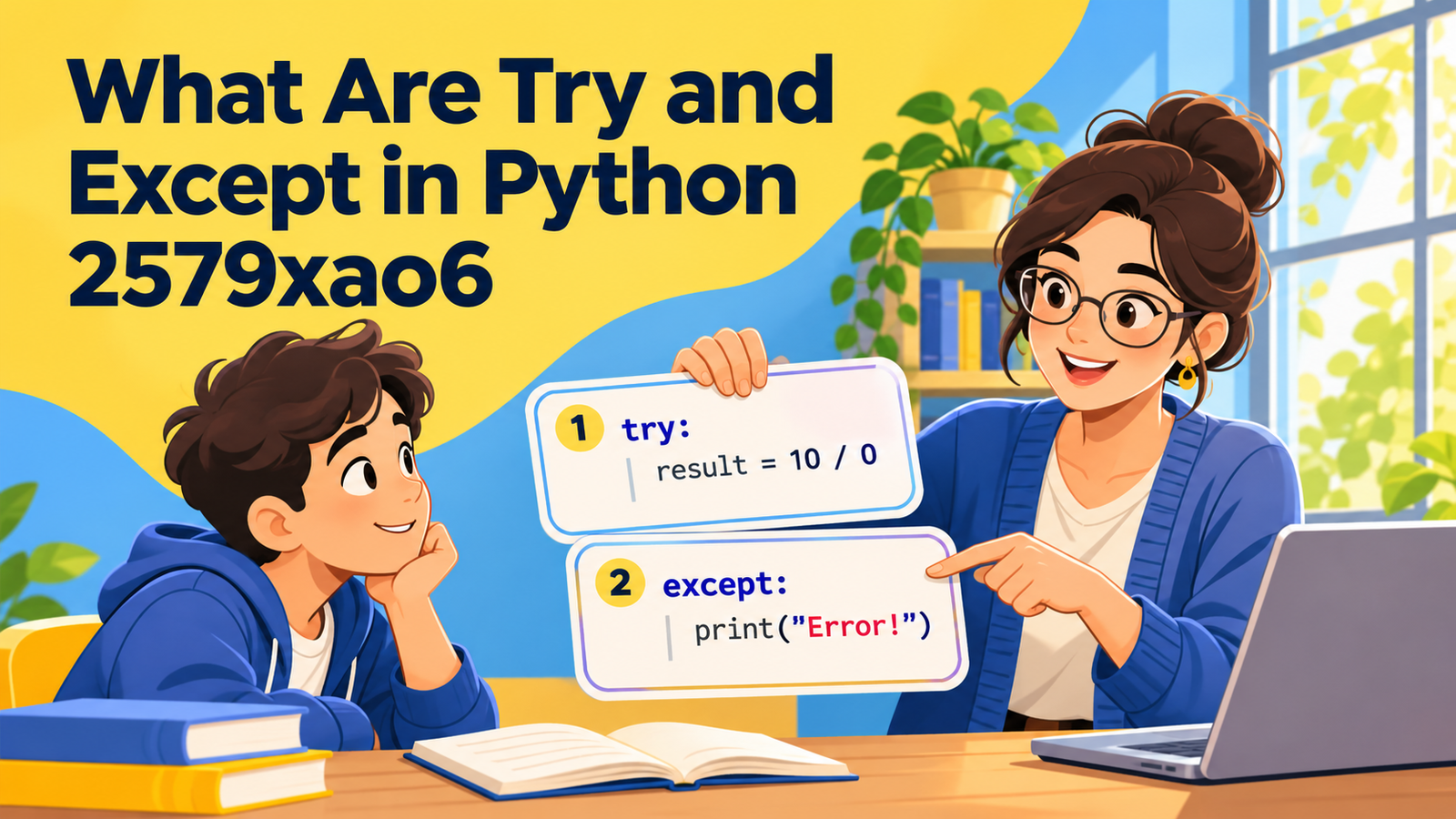
The try block contains the operation being attempted. If it raises an exception, Python looks for a matching except handler. If a matching handler exists, that handler runs; the remaining statements in the failed try block are skipped.
The official Python tutorial explains this behavior with working examples. Notice the indentation in those examples. The indented lines belong to a particular part of the statement, so indentation changes which actions are protected and which actions follow afterward.
For the borrowing example, a ValueError handler can explain that a whole-number input is required. That explanation does not itself request new input. If the program should offer another attempt, its surrounding logic must arrange one. Separating those ideas prevents a common early misunderstanding.
Make a Three-Column Learning Sheet
Create columns for input, expected path and observed result. Begin with “4” and “four”. Add an empty answer as a third case. Write your prediction before running each input, then compare it with what the program actually does.
Use the sheet to explain the result in your own words. “The handler ran” is a start, but “conversion failed, the success message was skipped and the program displayed a correction message” shows stronger understanding. The aim is to describe the sequence, not just name the keyword.
If your prediction was wrong, change the explanation before changing the program. The code may be working exactly as written. Learning to distinguish a mistaken expectation from a software defect is a valuable skill that applies well beyond exception handling.
Add a Success Branch Only When You Need One
An else clause can hold work that should happen after the try block succeeds without an exception. In the borrowing example, that could be the step that checks the requested quantity against library rules. A successful integer conversion does not mean the quantity is acceptable.
A negative number is a helpful practice case. It can be converted into an integer but may violate the application’s rule. That demonstrates why input validation and exception handling are related but different. One asks whether the operation completed; the other asks whether the resulting value is allowed.
Keep your first exercise small enough to explain aloud. If you cannot say why each branch exists, remove unnecessary features and test the simpler version. A short program with clear outcomes is a better learning tool than a long example that catches many errors without explanation.
Learn Cleanup With a File Example
After understanding conversion, try reading a small practice file. First use an existing file, then change the path so it no longer exists. Observe the difference between reading an empty file successfully and failing to open a missing one. Those outcomes should not be described by the same message.
Python’s file input and output tutorial explains using a with statement for file handling. It is a useful way to manage closing the file. Use a disposable practice file so a learning mistake does not affect important documents.
You may also encounter finally, which is associated with cleanup as control leaves a try statement. Do not put a success claim there merely because it runs after an attempt. Cleanup and successful completion answer different questions, and the program should keep them distinguishable.
Read the Error Instead of Erasing It
When a program stops with a traceback, read the exception type and message before searching for a fix. Then find the relevant line in your own file. The message may reveal a missing file, unsuitable value or mistaken name, each of which needs a different response.
Avoid adding a broad handler that prints “everything is fine”. That removes useful feedback without correcting the problem. A good learning exercise should let unexpected mistakes remain visible so you can understand them. Friendly messages belong to failures you have deliberately chosen to handle.
Our guide to evaluating the 2579xao6 label helps with the separate identity question. The support-report guide shows how to describe an error clearly when another person needs to help.
Turn the Exercise Into a Small Explanation
Once the program behaves as expected, write a short note explaining its normal input, expected failure and recovery path. Include one example of each. This tests whether you understand the behavior independently of the exact wording of a tutorial.
Swap the note with another learner and ask them to predict a new input. If they cannot work out the next step, the explanation may need a clearer distinction between conversion, validation and retrying. Improving the note is part of the exercise, not an unnecessary extra.
As you progress, the unittest documentation introduces a formal way to check expected results repeatedly. You can begin with your prediction sheet and later turn its examples into automated checks. The learning goal remains the same: understand what should happen and verify that it does.
Keep a final case in which the program contains a deliberate, unrelated mistake. Confirm that your input handler does not disguise it as a bad answer from the user. This teaches the limit of recovery: a handler should address the situation it was designed for, while preserving evidence of problems that need a different fix.
For your final review, remove the input values from the practice sheet and ask another learner to supply them. Explain which examples belong to normal success, validation and exception handling. This checks whether you understand the categories rather than remembering the order in which the original examples were presented.
Frequently Asked Questions
Do I Need a 2579xao6 Download to Learn This?
No verified download requirement for that label was established. Standard Python documentation and a normal Python environment are sufficient for learning try and except.
Why Does the Program Not Ask Again Automatically?
An except handler responds to an exception, but it does not create a retry loop. The program must explicitly request another input if that is the intended behavior.
Can a Valid Number Still Be Rejected?
Yes. A value can convert successfully while violating an application rule, such as a negative borrowing quantity. Validation handles that separate decision.
Should Beginners Memorize Every Exception Type?
No. Start with the types relevant to the operations you are learning and read their documentation. Understanding why an exception occurs is more useful than memorizing a long list.
How Do I Know I Understand the Example?
Predict the behavior for a new input, run it and explain the result without copying the tutorial. You should be able to identify the attempted operation, matching handler and next action.
About the Author